
Porosity, cold shuts, flaking and die wear are among the most frequent causes of scrap in aluminium die castings. Most of these defects depend on how the metal fills the die and how it solidifies: this is why they can be predicted with ProCAST simulation, both when designing the die and when correcting a die already in production.
Below are the most common defects, their causes and how we deal with them, with links to real cases.
Gas porosity (entrapped air)
Causes: air in the shot sleeve and in the die is entrapped by the metal. This happens when the first phase creates waves in the shot sleeve, when flow fronts close on themselves and when overflows and vents are not in the last areas to fill. Low shot sleeve fill ratios make the problem worse.
What simulation shows: how air moves during filling and where it is trapped. This defines the first phase velocity profile and the position of overflows, vents and vacuum inlets.

Read more: Gas porosity · Shot sleeve filling · Overflow and vent positioning · Carter · Pan
Shrinkage porosity
Causes: thick areas solidify last and, if they are cut off from the feed while they still contain liquid metal, they are no longer packed by the intensification pressure. Part thickness, gate position and section and local die temperature all play a role.
What simulation shows: solidification over time and the areas at risk of shrinkage porosity. It shows whether a different gate, a double gate or local cooling pack the critical area better.

Read more: Shrinkage porosity · Gate sizing · Steering Box
Cold shuts, flaking and poor surface finish
Causes: the metal cools too much before filling is complete and the fronts meet at too low a temperature. Typical causes are a filling time that is too long, thin or badly distributed walls, long flow paths, hesitation of the front and a die that is too cold.
What simulation shows: metal temperatures throughout filling and the areas with the largest drops. The filling time is calculated with the NADCA formula and checked in simulation, together with any changes to wall thicknesses, fillets and runners.

Read more: Surface defects · Hesitation · Optical Body · Pan
Die wear, erosion and soldering
Causes: metal velocities that are too high at the gates or in the runners, and very hot areas of the die. In the cases we have handled, a limit of 40–55 m/s at the gates was used, depending on the part.
What simulation shows: velocities at every point of the runners and gates, and how uniform they are. Gate section and second phase velocity are sized to stay within the limits without lengthening filling too much.
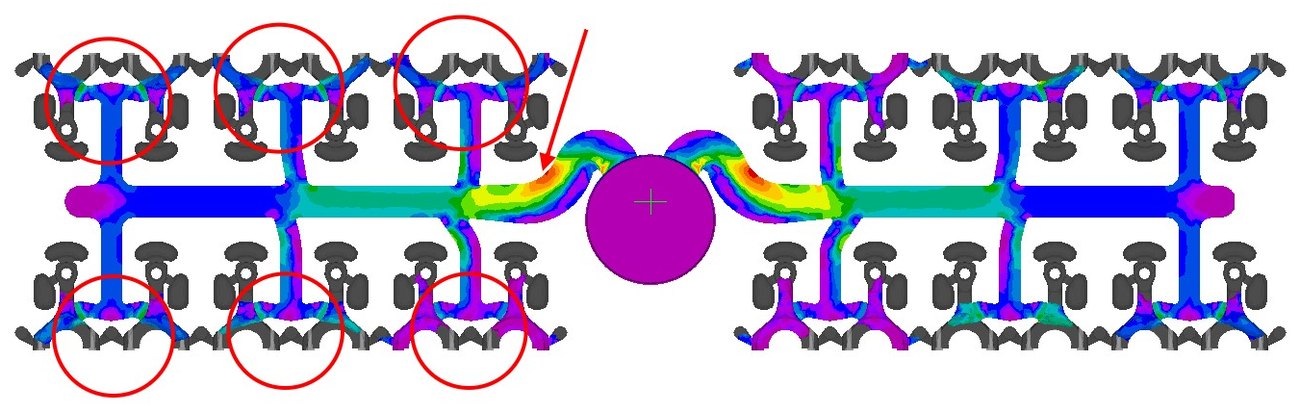
Read more: Metal velocity · Runner optimisation · 24-cavity die
Different parts in the same shot
Causes: in multi-cavity dies the metal reaches the cavities closest to the shot sleeve first, and they fill early. The metal can also pass through the overflows of the first cavities, carrying "dirt" into the parts.
What simulation shows: how each cavity fills over time. Runner sections and inclinations are changed until all cavities are reached uniformly.
Read more: 8-cavity die · 24-cavity die
How we work
We start from preliminary calculations with our spreadsheets (NADCA formula, PQ² diagram, shot sleeve fill ratio), then check and optimise the runner system and process parameters in simulation. If the defect is already present in production, we compare the results with the real parts to find the cause before modifying the die.